

Better Data, Better Decisions: What Captive Leaders Should Expect From Reporting
April 29, 2026 | All Things Captive



Modern reporting doesn’t appear overnight—it’s built.
At Innovative Captive Strategies (ICS), the reporting capabilities our members rely on today are the result of multiple years of deliberate investment in data foundations, governance, and integration. Building a trusted, usable data environment across Property & Casualty and Employee Benefits programs required time, iteration, and persistence—and it continues to evolve every day.
That journey matters, because meaningful insights can only come from reliable data.
Captive reporting has traditionally focused on hindsight—what happened last quarter, last year, or after a claim was already resolved. While those insights still have value, today’s captive leaders expect more. They want clarity in real time, visibility into current performance, and—most importantly—the ability to make informed adjustments before outcomes are locked in.
At ICS, we believe reporting should help captive members understand where they stand now and where they are headed—while there is still time to influence results.
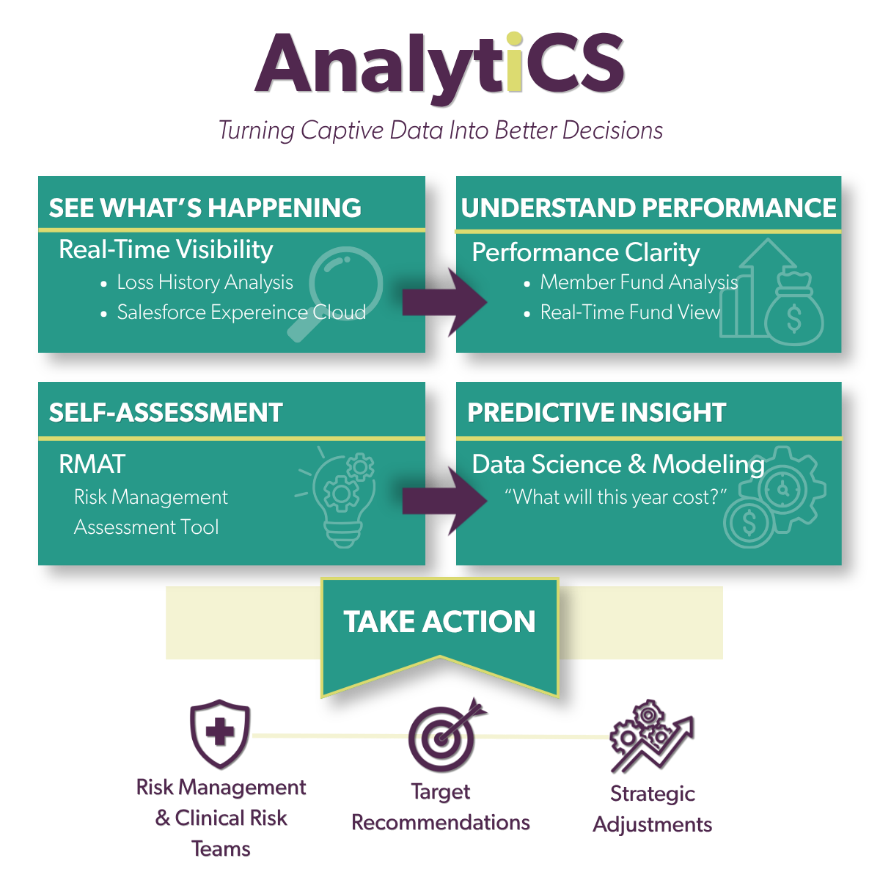
Real‑Time Insights on the ICS Member Portal
One of the most important changes in captive reporting isn’t just better analytics—it’s access. Through Salesforce Experience Cloud, ICS delivers reporting directly to members in a centralized and secure portal. This allows captive leaders to engage with data when they need it, not just when a scheduled report is delivered.
A key example is Loss History Analysis, which provides members real‑time visibility into claim performance as data updates. Instead of waiting for periodic summaries, members can:
- Monitor trends as they develop during the policy year.
- Prepare for board or management discussions using up-to-date information.
- Align internal stakeholders around a shared and trusted view of performance.
This approach shifts reporting from retrospective review to ongoing awareness.
Understanding Performance Inside the Captive: Member Fund Analysis
Member Fund Analysis was delivered on a semi‑annual basis—useful but delayed. Members often reviewed their position after financial performance had largely taken shape. That model is changing.
Soon, members will be able to view Member Fund Analysis in real time through the ICS portal, giving them timely insight into:
- How they are performing within the captive.
- How funding levels, losses, and allocations are evolving.
- How their results compare to expectations throughout the policy year.
This transparency allows members to stay informed with a proactive approach, rather than a reaction after the fact. It also creates a stronger foundation for planning, budgeting, and board conversations.
Looking Inward: RMAT as a Catalyst for Improvement
Performance isn’t defined by outcomes alone. It’s shaped by decisions, behaviors, and controls.
Our Risk Management Assessment Tool (RMAT) allows members to evaluate their own risk management practices across key areas. RMAT helps organizations:
- Assess the maturity of their risk management approach.
- Identify strengths and gaps objectively.
- Establish a baseline for improvement over time.
For members, RMAT enables self‑reflection grounded in data—not perception. For ICS, it provides insight that allows our teams to tailor recommendations based on each organization’s unique profile.
From “What Happened?” to “What Will This Year Cost?”
The next objective in captive reporting is forward‑looking insight. ICS is advancing data science initiatives that—after sufficient claim development—allow captive leaders to better understand expected outcomes, moving beyond retrospective analysis and toward informed planning for future policy years. They can now be proactive with questions such as:
- What will this policy year ultimately cost?
- Where are current trends pointing?
- Should we adjust risk management efforts or strategy now?
By combining historical data, real‑time performance indicators, and advanced analytics, these models help shift the conversation from claim review to cost projection and early intervention. This enables captive members and our Risk Management and Clinical Risk teams to:
- Evaluate whether current trends are acceptable or concerning.
- Adjust strategies before losses accumulate.
- Focus resources where they can influence outcomes most effectively.
Rather than waiting for results, members gain the ability to manage toward them.
Data‑Driven Guidance from Risk Management and Clinical Risk
Data is powerful, but its value is realized when paired with expertise. The ICS Risk Management teams use insights from Loss History Analysis, RMAT, and predictive analytics to:
- Identify priority improvement areas.
- Make targeted, data‑supported recommendations.
- Measure the impact of changes over time.
Similarly, our Clinical Risk teams leverage analytics to:
- Identify claims that may benefit from early intervention.
- Monitor treatment duration and cost drivers.
- Improve outcomes for injured employees while managing total cost of risk.
This collaboration turns reporting into action and insight into performance.
What Captive Leaders Should Expect
Modern captive reporting should occur in real time with visibility into current performance, not only past results. Reporting needs to support self‑assessment and accountability so captive members can look ahead instead of relying solely on lessons from past experiences. Finally, reporting should enable mid‑year course correction, not just post‑year explanation.
At ICS, reporting is built to support decision‑making when it matters most. If you are interested in finding out more about our innovative data reporting strategies, reach out to our team today!
Recent/Related Articles
-


Why Member Quality Matters in a Group Captive
September 3, 2026 | All Things Captive, Property Casualty
 Tim FlatteryVP, Shareholder
 -

Is an Employee Benefits Group Captive Right for Your Company? We Have the FAQs and Answers You Need to Succeed.
July 29, 2026 | All Things Captive
 Joey HajduchVP, Shareholder